

News
The Role of Mud Cleaners in Weighted Drilling Fluid Solids Control
Time:
2026-10-10
Weighted drilling fluids use materials such as barite to maintain the designed density and support wellbore pressure control. During drilling, drilled solids continuously enter the circulating system. If solids loading and particle-size distribution are not managed, rheology, filtration behavior, and pumping requirements can change. Discarding excessive weighting material with drilled solids also increases material consumption and waste volume. Solids control in a weighted system is therefore a balance: remove undesirable solids while retaining weighting material that can remain in service.
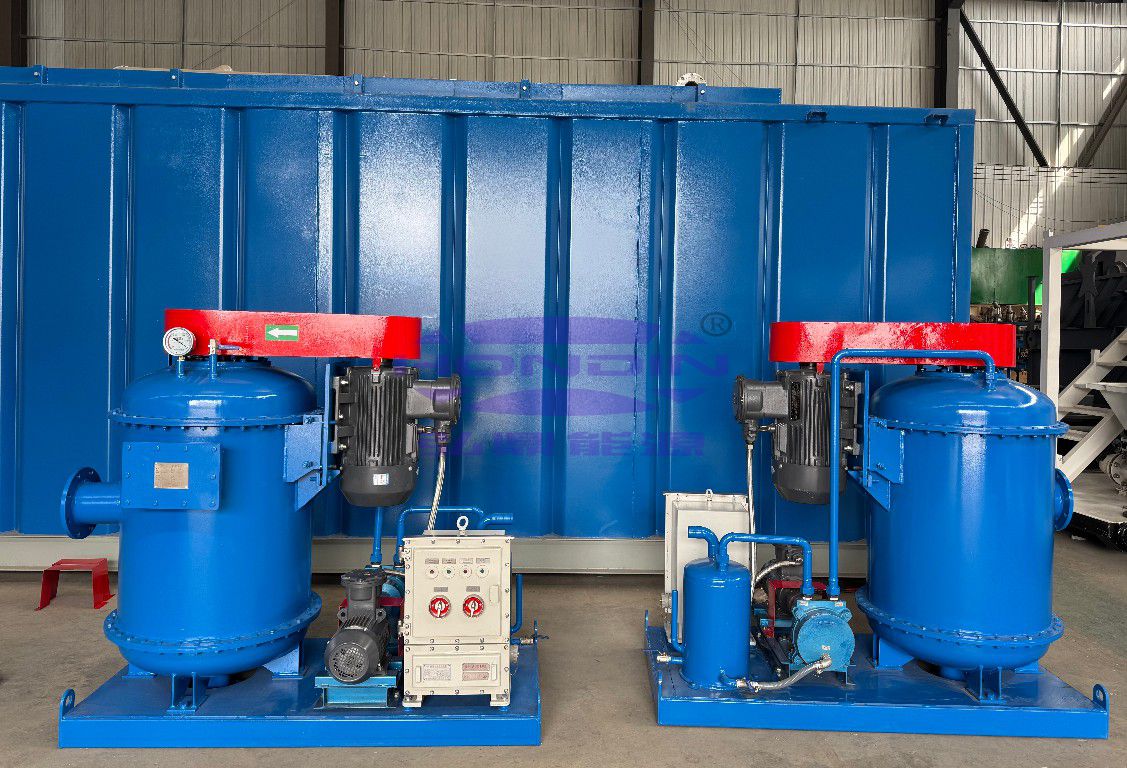
A mud cleaner commonly combines desander and desilter hydrocyclones with an underflow shaker screen. It treats the hydrocyclone underflow. The cones classify particles according to their behavior in the swirling flow; the resulting solids-and-liquid stream then lands on a fine screen. After screening and liquid drainage, coarser solids are discarded, while the screened liquid and finer material can return to the active system. Screening the underflow can reduce the loss of liquid and some weighting material while removing coarser drilled solids. Actual recovery depends on particle size and density, mud viscosity, screen specification, and operating conditions; it is not guaranteed by the equipment name alone.

In a typical solids-control train, shale shakers remove larger cuttings first. The fluid then passes through desanding or desilting equipment according to the system design. A mud cleaner is commonly installed downstream of these cones to screen their underflow. It does not replace shale shakers, standalone desanders or desilters, or decanter centrifuges, and should not be treated as a single unit that performs every solids-control duty. For weighted mud, equipment selection should account for mud density and rheology, the solids-control target, and the particle-size distribution of the weighting material.
Throughput and hydrocyclone condition are among the first factors affecting performance. Low or unstable feed pressure and worn cones can reduce separation efficiency. High viscosity can also change the flow field inside a hydrocyclone. A screen that is too coarse may allow more solids to return with the screened fluid; one that is too fine may reduce capacity, blind more readily, or require more frequent maintenance. Match cone sizes, screen mesh, and feed conditions to manufacturer guidance and representative mud tests. Verify performance by monitoring underflow behavior, liquid retained on discarded solids, recovered-fluid quality, and changes in mud properties.
When specifying a unit, review rated capacity against circulation-system flow rate, cone quantity and size, screen area and vibration, ease of screen replacement, wear liners and spare-parts availability, and connections to site tanks and manifolds. For high-viscosity or high-density fluids, or applications with fluctuating solids loading, provide the supplier with representative mud data and consider a field test rather than relying on nominal capacity alone.

Routine checks include inspecting cone nozzles and liners for wear, confirming screen tension and integrity, watching for abnormal spray or rope-like underflow, and clearing blinded openings. Operators should record feed pressure, flow rate, screen specification, and mud properties so adjustments are based on evidence. A mud cleaner can support particle classification and weighting-material recovery, but overall results depend on coordination across the solids-control train, the mud-maintenance program, and actual field conditions.
Click:








文章推荐
Hot News
-

Chemical Hot Washing for Oily Sludge: Process Stages and System Evaluation
-
The Role of Mud Cleaners in Weighted Drilling Fluid Solids Control
-
Waterflooding and Scale Control in Mature Oilfields
-
Gas Flotation in Produced Water Treatment Systems
-
Mud Agitator Role and Selection for Solids Control
-
Surface Fluid Systems for Acidizing Operations
-
Vertical Cuttings Dryer for Drilling Waste Management
-
Desander vs Desilter Selection for Solids Control
-
Surface Blending and Pumping Systems for Well Stimulation
-
Produced Water Pretreatment for Reinjection and Reuse
-
Vacuum Degasser Role in Drilling Fluid Solids Control
-
Decanter Centrifuge for Oily Sludge Dewatering



Add: No.462 Jinggao South Road, Gaoling District, Xi'an, Shaanxi Province, China
Mob/WhatsApp: +86 186 2931 2932/ +86 187 2900 8271
E-mail: sales@hondinchina.com

Follow us:

点击右上角
分享给朋友吧
点击右上角
分享给朋友吧
Copyright © Xi'an Hondin Energy Technology Co., Ltd. All rights reserved
Copyright © Xi'an Hondin Energy Technology Co., Ltd. All rights reserved