

News
Oil, are we out of it?
Time:
2024-07-09
At the dawn of the 20th century, the most foul-smelling environmental challenge facing the world's cities was not slums, sewage or coal ash, but horse manure. In London in 1900, about 300,000 horses pulled taxis and stagecoaches, as well as wagons, flatbeds and haywagons, leaving a trail of horse manure in their wake. New York City has 100,000 horses, and its citizens endure the same problem - they have to wade through flowing sewage on rainy days and through fly-flying dung piles on sunny days. At the first international urban planning conference, held in New York in 1898, manure was at the top of the agenda. Nothing could be done about it, and disappointed delegates headed home a week early.

A decade later, however, the dung problem has been all but wiped out by the invisible hand of the market. Henry Ford produced the first Model T. It was cheap, fast and clean. By 1912, cars outnumbered horses in New York, and the last horse-drawn streetcar was retired in Manhattan in 1917. It's a sign of oil maturity.
It was an age of speed, an age of acceleration most of the time. If coal powered the industrial revolution, oil brought the internal combustion engine, aviation and a new twentieth-century belief in human possibilities. It allowed humans to fly to the moon and beyond. From lipstick to CD players, from motorcycle helmets to aspirin, many products that have changed human lives contain petrochemicals. Tractors and fertilisers brought cheaper food to the world, and plastic for packaging was a boon to petroleum products.
Oil has changed history. The past 100 years have been marked by oil wars, oil crises and oil spills. Even in the 21st century, the dominance of oil remains entrenched. It may have sped everything else up, but there is a rule of thumb in energy markets that changing the fuel mix is as slow as a glacier melting (see chart).
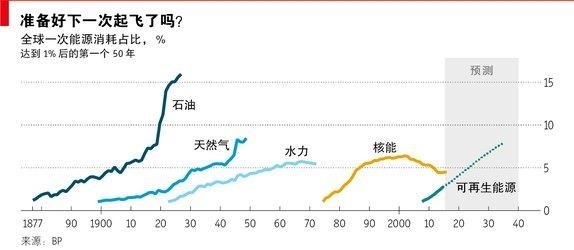
Oil's share of global energy supply peaked at 46% in 1973, at the time of the Arab oil embargo. It still had a 31% share in 2014, compared with 29% for coal and 21% for natural gas. Fossil fuels' fast-growing competitors, such as wind, solar and geothermal energy, add up to little more than 1%.
Yet the shift from "horsepower to horsepower," a phrase coined by Eric Morris of Clemson University in South Carolina, epitomizes our times. A hundred years ago, oil was seen as an environmental savior. Today, petroleum products have increasingly become the same threat to public health and the environment as horse manure did back then.
Despite its enduring popularity, oil may be facing the same moment as the Model T. The danger is not that demand will collapse soon, but that investment strategies are shifting from finding new sources of oil to finding alternatives. The immediate catalyst is the world's response to climate change. The agreement reached in Paris presents a 50-50 chance of limiting global warming to no more than 2 ° C above pre-industrial levels, and possibly even 1.5 ° C. This was seen by some as a sign of a war on fossil fuels.
In 2014, coal was responsible for 46% of global fuel-related carbon dioxide emissions, compared with 34% for oil and 20% for natural gas. Natural gas is likely to be the fossil fuel of last resort because it is relatively clean. Many believe that natural gas and renewable energy generation will be the first step in a comprehensive reform of the global energy system.
Oil is the largest component of the energy industry and the world's most traded commodity, with exports worth about $1.5 trillion a year. Half of the top 10 listed companies on the Fortune Global 500 produce oil, and the unlisted Saudi Aramco dwarfs all of them.
Oil revenues prop up the countries that bring stability to global geopolitics, as well as those in the hands of tyrants and terrorists. Oil products drive 93 percent of global transportation, so its price affects almost everyone.
Since crude prices began to fall in 2014, the world has had a glimpse of the havoc a flagging oil industry could wreak. Oil producers such as Venezuela and Nigeria have suffered budget blowouts and social unrest, and some U.S. shale companies have gone bankrupt. But it has also had some positive effects. Saudi Arabia has begun planning to reduce its economy's dependence on oil and has announced it will partially privatize Aramco. Other Middle Eastern oil producers have embraced solar power. Some oil-consuming countries have taken advantage of low prices to cut fuel subsidies.

Oil will also be used to power heavy goods vehicles, aircraft and ships and to make plastics for many years to come. But from the United States to China, vehicle emission standards have become more stringent, squeezing more mileage out of less fuel. Air pollution and congestion in big cities are pushing countries like China and India to look for alternatives to gasoline and diesel as transportation fuels. Car companies such as Tesla, Chevrolet and Nissan have announced plans to sell long-range electric vehicles at subsidized prices of about $30,000, making them more affordable. Around the world, the role of energy in GDP growth is diminishing.
Some analysts believe the Paris agreement will mark a turning point in global efforts to reduce carbon dioxide emissions. They say global oil consumption could start to decline as early as the 2020s. This will mean that the company will not
Instead of focusing on oil that is easy to extract, such as oil from the shale provinces of the Middle East and the Americas, focus on expensive and complex projects with long payback periods, such as the Arctic, Canadian oil sands or deep-sea oil.
However, many in the industry continue to scoff at the notion of peak demand. They are not convinced that governments have the political will to meet climate goals at the pace envisaged in the Paris agreement. In the United States, they scoff at the idea that the nation on wheels could quickly abandon gasoline. Khalid Al-Falih, Saudi Arabia's energy minister, estimates that the world will still need to invest nearly $1 trillion a year in oil over the next 25 years. Oil veterans point out that even if global oil consumption is near its peak, the world will still need to replace existing Wells, which are being consumed at a rate of up to 5m barrels a day a year - about the amount added in four years of the US shale revolution. Demand is not about to fall off a cliff.
Click:








文章推荐
Hot News
-

Chemical Hot Washing for Oily Sludge: Process Stages and System Evaluation
-
The Role of Mud Cleaners in Weighted Drilling Fluid Solids Control
-
Waterflooding and Scale Control in Mature Oilfields
-
Gas Flotation in Produced Water Treatment Systems
-
Mud Agitator Role and Selection for Solids Control
-
Surface Fluid Systems for Acidizing Operations
-
Vertical Cuttings Dryer for Drilling Waste Management
-
Desander vs Desilter Selection for Solids Control
-
Surface Blending and Pumping Systems for Well Stimulation
-
Produced Water Pretreatment for Reinjection and Reuse
-
Vacuum Degasser Role in Drilling Fluid Solids Control
-
Decanter Centrifuge for Oily Sludge Dewatering



Add: No.462 Jinggao South Road, Gaoling District, Xi'an, Shaanxi Province, China
Mob/WhatsApp: +86 186 2931 2932/ +86 187 2900 8271
E-mail: sales@hondinchina.com

Follow us:

点击右上角
分享给朋友吧
点击右上角
分享给朋友吧
Copyright © Xi'an Hondin Energy Technology Co., Ltd. All rights reserved
Copyright © Xi'an Hondin Energy Technology Co., Ltd. All rights reserved