

News
Core equipment of mud-free system
Time:
2025-12-23
With increasingly stringent environmental regulations in the drilling industry, non-discharge drilling mud systems have become core equipment for achieving the reduction, harmlessness, and resource recovery of drilling waste. This system, through the coordinated operation of multiple devices, precisely separates waste drilling mud returned from the wellhead into reusable liquid phase, disposable dry mud cake, and recyclable resources, eliminating environmental pollution at its source. As a company deeply rooted in the drilling environmental protection equipment field, we combine years of project experience to provide you with a detailed breakdown of the core equipment components of a non-discharge drilling mud system, helping you fully understand the system configuration logic and key selection criteria.
I. Pretreatment Unit
The core function of the pretreatment unit is to remove large particulate impurities from the waste drilling mud, adjust the physicochemical properties of the mud, reduce the processing load of subsequent equipment, and ensure separation efficiency.
Drilling Mud Receiving Tank: As the system's 'buffer hub,' it is responsible for temporarily storing the waste drilling mud returned from the wellhead. The tank is equipped with an explosion-proof agitator to effectively prevent solid particles from settling and caking. It also features a precision dosing port for pre-injecting demulsifiers and flocculants based on mud characteristics, pre-treating the mud and creating favorable conditions for subsequent solid-liquid separation.
High-frequency vibrating screen: The core screening equipment in the pre-treatment stage, it rapidly removes large particles such as drill cuttings and rock fragments with a diameter ≥74μm from the mud through high-frequency, low-amplitude vibration.

II. Core Solid-Liquid Separation Unit.
The solid-liquid separation unit is the core component of the mud-free system, directly determining the mud treatment effect, resource recovery rate, and environmental compliance. Core equipment includes centrifugal separation and pressure filtration.
Horizontal screw centrifuge: Performs deep separation of fine solid particles (2-74μm) in the mud, utilizing centrifugal force generated by high-speed rotation to achieve precise solid-liquid stratification. The water content of the separated solid phase can be reduced to below 20%, and the solid content of the liquid phase is significantly reduced, allowing for direct reuse in drilling fluid preparation and significantly improving resource utilization. For oil-based mud treatment scenarios, we can equip the system with disc centrifuges to further separate the oil from the liquid phase, achieving efficient oil recovery. Chamber/plate/frame filter presses: suitable for deep dewatering of high-solids-content, high-viscosity mud, they use high-pressure extrusion to completely squeeze out the liquid phase from the mud, forming dry mud cakes with a moisture content of 15%~25%. These dry mud cakes can be directly transported for landfill or further processed into building fillers and roadbed materials, realizing solid waste resource utilization. The equipment is equipped with an automatic plate-pulling system, enabling automatic unloading of the mud cakes and significantly reducing manual labor intensity.
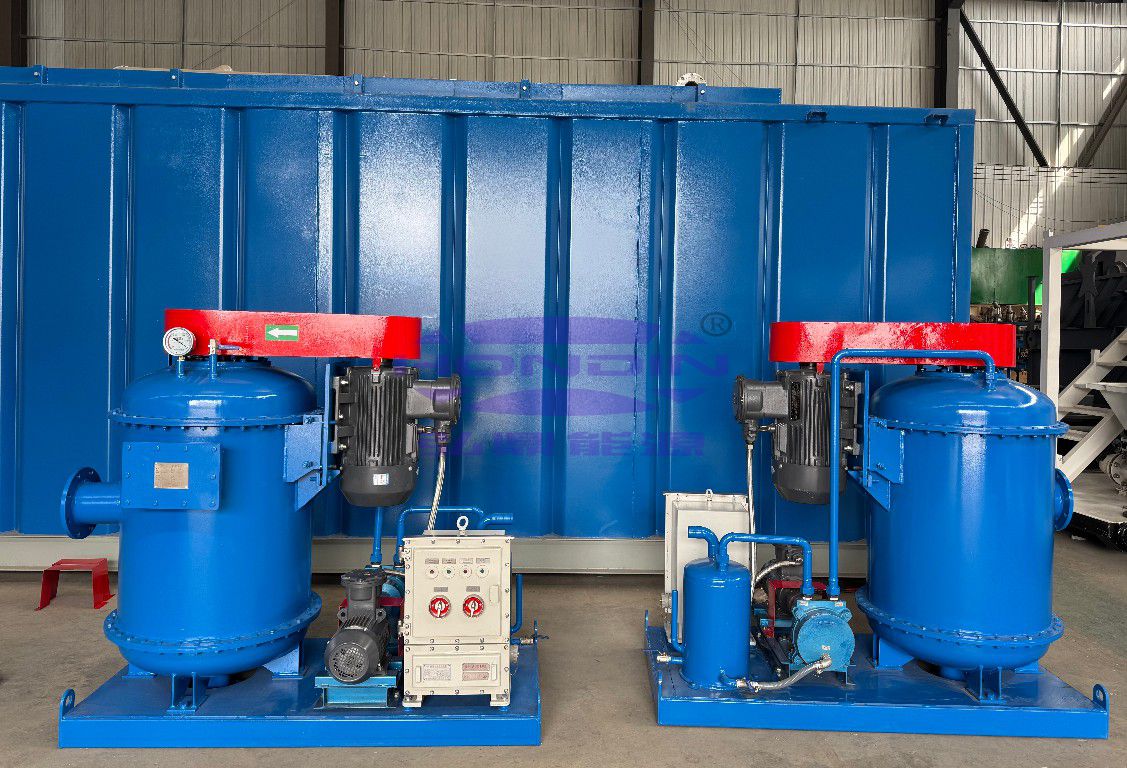
Cyclone separators (optional): including desanders and desilters, they separate medium-sized solid particles through cyclone centrifugation. Often used in conjunction with centrifuges, they form a 'cyclone coarse separation + centrifugal fine separation' staged separation process, effectively improving overall processing efficiency, reducing the operating load of centrifuges, and adapting to high-volume drilling conditions.
III. Conveying and Transfer Unit.
The conveying and transfer unit is the system's 'logistics link,' responsible for the precise flow of slurry between various equipment, while simultaneously transporting the separated dry slurry cake and clear liquid phase to designated locations, ensuring continuous and stable system operation.
Specialized Conveying Pumps: Pump types are precisely matched to the slurry characteristics—screw pumps are suitable for conveying high-viscosity, high-solids-content slurry, eliminating the risk of clogging; slurry pumps are suitable for conditions with high sand content, offering high conveying efficiency; metering pumps are used in the dosing system to precisely control the dosage of chemicals, avoiding waste.
Solid Waste Transfer Equipment: Screw conveyors are responsible for transporting the solid phase separated by vibrating screens and centrifuges to filter presses or silos, with a closed design to prevent dust emissions; belt conveyors are suitable for high-volume processing conditions, efficiently transporting the dry slurry cake produced by the filter press to transport vehicles, achieving automated transfer; filtrate collection tanks are specifically designed to store the separated clear liquid phase, equipped with level monitoring devices for unified reuse or compliant discharge.

IV. Auxiliary Control Unit.
The auxiliary control unit is responsible for optimizing system operating parameters, ensuring environmental compliance, and achieving intelligent management and control to reduce operation and maintenance costs. It is an important component of modern non-landing mud systems.
Intelligent Dosing System: Composed of a chemical storage tank, metering pump, and static mixer, this system uses sensors to monitor parameters such as mud solids content and viscosity in real time, automatically adjusting the chemical dosing amount to ensure stable separation results and avoid chemical waste. For oily mud, an additional deoiling agent dosing device can be equipped to enhance oil-water separation.
Environmental Auxiliary Equipment (Optional): A drill cuttings dryer is used for deep treatment of oil-based mud drill cuttings, reducing the oil content to below 3% to meet environmental disposal standards; the exhaust gas treatment device (activated carbon adsorption tower, flare combustion system) is used to treat volatile organic gases generated during the drying process, preventing air pollution and fully complying with environmental requirements.
PLC Intelligent Control System: Integrates multi-dimensional online monitoring instruments to monitor system operation status in real time and automatically adjust key parameters such as centrifuge speed and filter press pressure; supports remote control and fault early warning, enabling unmanned operation, significantly reducing maintenance costs and improving system stability.
V. Customized Configuration: Adaptable to Different Drilling Conditions
Based on the characteristics of different drilling conditions, we can provide customized equipment configuration solutions: The water-based mud treatment system is centered on a 'vibrating screen + centrifuge + filter press,' focusing on solid-phase drying and liquid-phase reuse, with a simple and efficient configuration; the oil-based mud treatment system requires additional equipment such as a drill cuttings dryer, disc centrifuge, and solvent recovery device to achieve oil recovery and compliant disposal of drill cuttings, fully adapting to stringent environmental protection requirements.








Hot News
-

Chemical Hot Washing for Oily Sludge: Process Stages and System Evaluation
-
The Role of Mud Cleaners in Weighted Drilling Fluid Solids Control
-
Waterflooding and Scale Control in Mature Oilfields
-
Gas Flotation in Produced Water Treatment Systems
-
Mud Agitator Role and Selection for Solids Control
-
Surface Fluid Systems for Acidizing Operations
-
Vertical Cuttings Dryer for Drilling Waste Management
-
Desander vs Desilter Selection for Solids Control
-
Surface Blending and Pumping Systems for Well Stimulation
-
Produced Water Pretreatment for Reinjection and Reuse
-
Vacuum Degasser Role in Drilling Fluid Solids Control
-
Decanter Centrifuge for Oily Sludge Dewatering



Add: No.462 Jinggao South Road, Gaoling District, Xi'an, Shaanxi Province, China
Mob/WhatsApp: +86 186 2931 2932/ +86 187 2900 8271
E-mail: sales@hondinchina.com

Follow us:

点击右上角
分享给朋友吧
点击右上角
分享给朋友吧
Copyright © Xi'an Hondin Energy Technology Co., Ltd. All rights reserved
Copyright © Xi'an Hondin Energy Technology Co., Ltd. All rights reserved