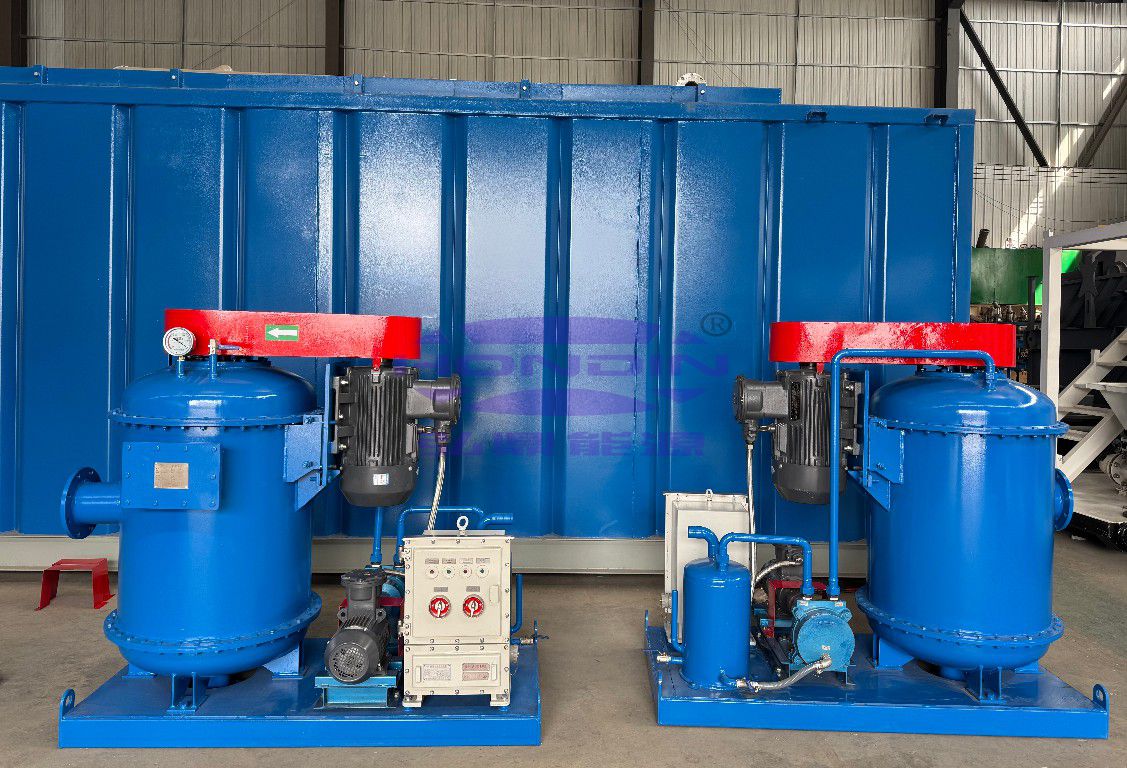
In oil & gas exploration, tunnel boring, and deep-sea piling projects, mud treatment often faces 'hell-level' challenges: ultra-high viscosity in shale formations, high-salt environments in deep seas, and complex compositions in karst landscapes... These special geological conditions act as 'roadblocks,' frequently causing conventional treatment technologies to fail. This article reveals how engineers develop 'customized' solutions for different geological hurdles, transforming mud treatment from a 'daunting task' into an 'efficient process.'

Mud in complex geological conditions exhibits three typical characteristics that fundamentally disrupt conventional treatment logic:
- Complex and Variable Compositions: Mud from shale gas extraction often contains heavy metals and polymer additives; mud in karst areas carries large amounts of calcium carbonate particles and cave silt, rendering traditional flocculants ineffective.
- Extreme Physical Properties: Deep-sea mud becomes gelatinous under high pressure and low temperatures, with extremely poor fluidity; mud in permafrost regions freezes as hard as rock, prone to clogging and wearing equipment.
- Stringent Environmental Restrictions: Ecological protection zones demand 'zero pollution' discharge, while offshore platforms have limited space for large treatment equipment, requiring processes to balance environmental protection and space efficiency.
To overcome these 'tough nuts,' engineers have developed innovative solutions such as media-specific treatment and modular process design, ensuring 'the right tool for the job.'
Shale gas drilling mud, thickened by polymer additives, can have a viscosity of 80–120 seconds (compared to 20–30 seconds for conventional mud) and often contains heavy metals like mercury and cadmium. The treatment team employs a 'composite gel-breaking + chelating precipitation' technology:
- Chemical Gel-Breaking: A specialized bio-enzyme preparation is used to decompose polymer chains into small molecules via enzymatic reactions, reducing mud viscosity by 70%.
- Heavy Metal Capture: A novel chelating agent forms stable complexes with heavy metals. After plate-and-frame filtration, the removal rate of heavy metals exceeds 95%, meeting Hazardous Waste Identification Standards.
In the Changning shale gas field (Sichuan), this technology shortened mud treatment time per well from 7 days to 3 days, with heavy metal emissions less than 1/10 of the national standard.
Mud from deep-sea platform piling contains up to 3.5% salt and must be treated in limited space. Engineers designed a mobile 'low-temperature distillation + membrane separation' integrated system:
- Low-Temperature Distillation: A vacuum environment lowers the boiling point of water, enabling rapid dewatering at 50°C to prevent salt crystallization and equipment clogging.
- Reverse Osmosis Membrane Module: Pollution-resistant seawater desalination membranes with nanometer-level filtration precision produce fresh water with<500 mg/L salinity, suitable for reuse.
This compact system (1/3 the size of traditional equipment) processes 200 cubic meters of mud daily on a South China Sea drilling platform, with a fresh water recovery rate exceeding 85%.
Mud in karst areas often contains over 40% sand, while cave silt has high microbial activity, prone to putrefaction and odor. The innovative 'cyclone desanding + biological stabilization' process is used:
- Three-Stage Cyclone Separation: Combined cyclones of varying diameters efficiently separate ≥0.074 mm sand particles with a 98% recovery rate. The separated sand can directly reinforce roadbeds.
- Biological Agent Treatment: Specialized microbial communities decompose organic matter in silt, eliminating odors and reducing COD (chemical oxygen demand) by over 60%. In a Guizhou tunnel project, this technology cut treatment costs by 30% and generated over ¥1 million in revenue from recycled sand.
In -20°C permafrost, mud freezes rapidly, disabling traditional equipment. The team developed a 'constant-temperature treatment chamber + microwave thawing' system:
- Intelligent Temperature Control: A double-insulated chamber with heating elements and circulation maintains mud at 5–10°C.
- Microwave-Assisted Thawing:(directional microwave heating) restores fluidity within 30 minutes without altering mud chemistry. Used in a Qinghai-Tibet Railway section, the equipment operated stably for 200 days, ensuring continuous winter construction.
To adapt to diverse geological needs, modern mud treatment systems use a modular design: Standardized functional units (vibration screening, centrifugal separation, chemical treatment) can be combined like 'building blocks.' For example:
- Oil-Based Mud Projects: Combine 'centrifugal separation + solvent extraction modules' for efficient oil recovery.
- Urban Metro Construction: Use 'mobile filtration + wastewater reuse modules' to minimize site occupation and transportation costs.
This flexible configuration enhances solution suitability by 90% and shortens project cycles by an average of 40%.
Breakthroughs in complex geological mud treatment have not only solved engineering challenges but also advanced the industry toward greener and more efficient practices:
- Significant Environmental Benefits: Heavy metal compliance rates have risen from 65% to 98%, with wastewater reuse rates exceeding 80%.
- Substantial Cost Reduction: Resource recycling (e.g., sand reuse, oil-based mud regeneration) has cut treatment costs by 40% in some projects.
- Improved Construction Efficiency: Shorter treatment cycles have accelerated drilling and tunneling by 20–30%, supporting super-project timelines.
From the Tarim Basin's shale fields to the Mariana Trench's research platforms, mud treatment technologies are overcoming geological 'forbidden zones' through innovation. In the future, with the integration of AI, nanomaterials, and other cutting-edge technologies, these 'geological...